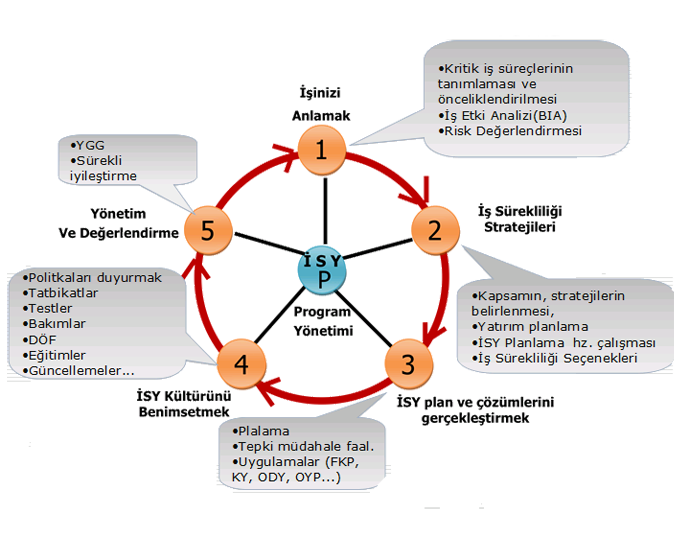





It is difficult to give a single definition of business continuity. Although many definitions have been offered, each emphasizes a specific point in the process. However, if we try to give a general definition, business continuity can be defined as the ability of an organization to respond to any interruption in the execution of a task within a predetermined framework of principles and rules. From this perspective, business continuity can also be defined as the set of processes, rules, or decisions that enable an organization to intervene in interruptions that cause disruptions to its operations.
Interruptions in these definitions generally refer to events that occur outside the control of the organization. But sometimes an event under the knowledge or control of the organization may also create an interruption. For example, an arrangement to improve the organization's activities may lead to an unexpected outcome. Such events should also be considered in the context of business continuity.
An organization has identified a number of processes to carry out its activities without disrupting its operations, whether it be small or large. The basis of the business continuity studies is how much interruption of these processes can be removed, what will be done in order to eliminate the situation that causes disruption, and to restart the process, and how long it takes for the work to be done. If these identified issues are identified from the beginning and the application methods are explained, business continuity is ensured and the damages resulting therefrom are eliminated as soon as possible.
The first standardization efforts regarding business continuity were initiated in 2003 by the British Standards Institution (BSI). However, these standards were later withdrawn, and in 2006, BS 25999-1:2006 Business Continuity Management: Rules of Practice were published. These standards outline the policies, procedures, and requirements for business continuity management. BS 25999-2:2007 Business Continuity Management: Requirements, released in 2007, addressed extremely critical points regarding business continuity. By 2012, these standards were published as the ISO 22301:2012 Business Continuity Management System standard and adopted by more than 150 countries.
After 2012, organizations with BS 25999 standard have converted this system into new standards.
One of the most important systems to manage effectively in an organization is the ISO 22301 Business Continuity Management System . Its importance is generally not understood until a disruption occurs, but if a disruption happens and is not managed well, it can cause significant losses for the organization.
In general, emergency plans that regulate the work to be carried out in the event of a disaster and business continuity are mixed together. However, while emergency plans only regulate a catastrophic situation, business continuity studies are carried out in every situation that prevents activities to be carried out properly outside of disaster situations. Therefore, while business continuity studies mainly involve strategies to prevent disruptions, contingency plans regulate post-disaster work. In other words, a sub-process of the Business Continuity Management System is considered to make an emergency clearance plan. In general, emergency clearance plans cover information technology studies.
Organizations operating in all sectors, regardless of size, can implement ISO 22301 standards. Any organization, regardless of its transaction volume or number of employees, can implement this system and obtain ISO 22301 Business Continuity Management System Certification . Even very large organizations can implement this system for a specific unit within their organization.
Thanks to this system, necessary plans are made and implemented in order to ensure the continuity of the work done and the organizations are prepared for what to do in case of an interruption. In this way, the effect of events that create disruptions is mitigated, critical functions are maintained during the interruption and reputation is gained against the organization rivals. In today's heavy competition environment, gaining image is a serious situation. The brand values of organizations increase and trust is created by customers.
In short, ISO 22301 Business Continuity Management System ensures that an organization is prepared when an event occurs that could disrupt its operations. It is a documented management system designed to mitigate the effects of the disruptive event and allow the process to continue from where it left off.
These system standards, as in all quality systems in general, include the recognition of the organization, commitment of senior management, planning, determination of needs and expectations, allocation of resources, operation of the process, performance measurement, analysis and evaluation and regulatory and preventive activities.